
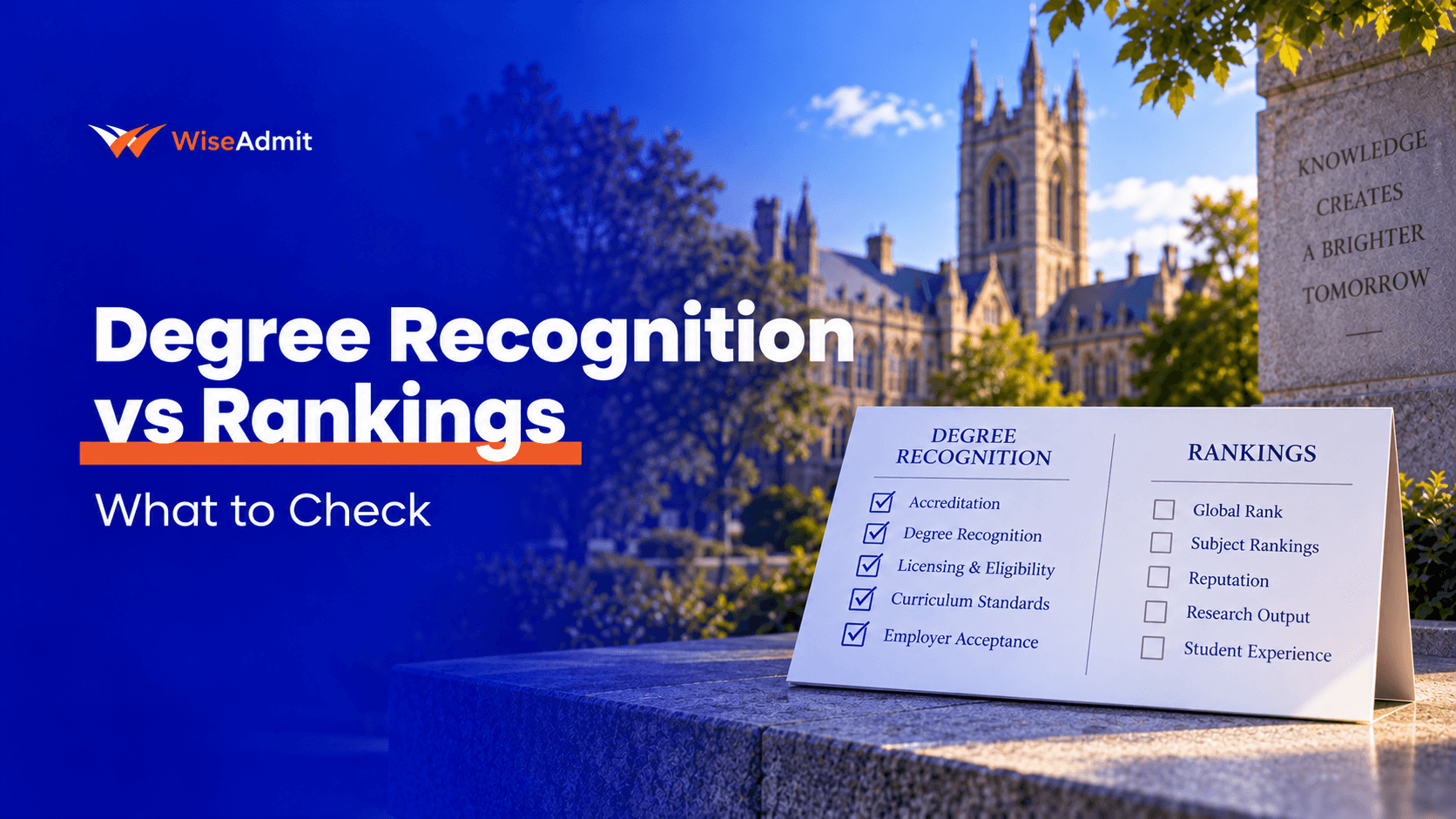

The short answer: A ranking can help you discover institutions, but it cannot tell you whether the specific qualification is officially recognized, fits your career or will be accepted where you want to work. Check the awarding institution, program status and destination-country rules separately.
Students often compare “University A is 50 places above University B” without asking whether the two degrees teach the same subject, include the required placements, or qualify graduates for professional registration. Those are different questions with different sources.
Four checks, four sources
| Check | Best source |
|---|---|
| Institution is legally recognized | National ministry, regulator or official quality-assurance register |
| Specific program is approved where required | Program register or professional accrediting body |
| Qualification can be used for further study | Receiving university or credential-recognition body |
| Qualification can lead to a regulated profession | Licensing body where you plan to practice |
The ENIC-NARIC guidance on recognized higher-education institutions explains that country systems differ and that some require program-level accreditation in addition to institutional recognition. Its country pages point to official national information. These checks matter more than a marketing badge from a ranking publisher.
Recognition is not always automatic across borders
A degree that is valid in the country where it was awarded may need an evaluation elsewhere. The ENIC-NARIC recognition guide says responsibility may sit with the receiving institution, ministry or national information center. UNESCO's Global Convention supports fairer recognition processes; it does not mean every degree is automatically accepted for every job in every country.
This is especially important if your goal is a regulated profession. Ask the licensing authority which program features it requires—course credits, supervised practice, exams or a specific accreditation. A broad statement such as “internationally recognized” is not enough.
Evaluate the actual course
Open the current curriculum. Compare required modules, elective freedom, research or laboratory access, internship design, teaching language, assessment method and total duration. Check whether a placement is guaranteed, competitive or simply “available.” Ask current students or recent graduates what the workload and support look like, while remembering that one person's experience is not representative.
Look at outcomes carefully. A university-wide employment statistic may not describe the course you want. Ask for the cohort, year, response rate, geography and definition of “employed.” If the institution cannot provide that detail, do not turn a promotional percentage into a financial forecast.
Then examine cost and fit. EducationUSA's research guidance says there is no official US college ranking system and emphasizes academic, financial and personal match. That logic is useful worldwide, even though each country has different regulations.
A practical shortlist filter
Start with subject and degree level. Eliminate unrecognized options or programs that cannot meet a required licensing route. Next, compare curriculum and admission eligibility. Then calculate the full net cost and available funding. Only then use rankings or reputation as one secondary signal among several.
This order prevents a prestigious name from masking a poor course fit or a financial commitment you cannot sustain. It also prevents “cheap” options from slipping through without official recognition.
Frequently asked questions
Does accreditation guarantee a job abroad?
No. It can establish an important quality or licensing condition, but employment and professional registration depend on additional rules and individual circumstances.
Can an employer reject a valid foreign degree?
Employers set role requirements, and regulated professions may have formal recognition processes. Ask the relevant body in your target country before committing to the degree.
Next step: Explore universities and study-abroad destinations, then verify each shortlisted degree with the official bodies relevant to your career plan.
Source notes: ENIC-NARIC institution recognition; academic recognition; UNESCO Global Convention; EducationUSA research options. Reviewed 13 October 2026.


