Tibet University
 Facebook
 Instagram
 Youtube
 Tiktok
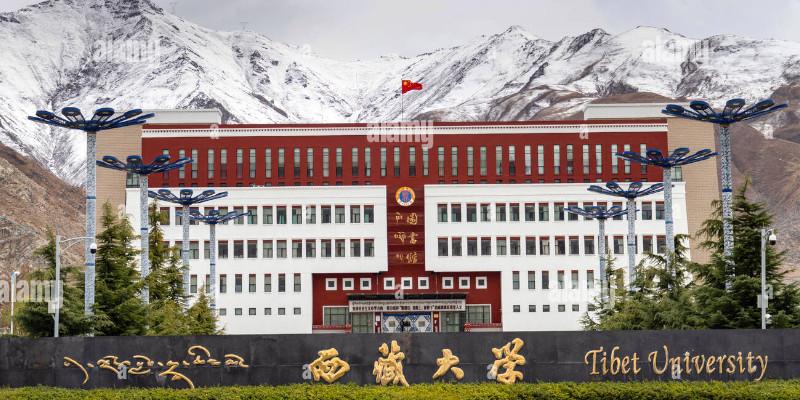
Tibet University is a comprehensive university affiliated to the Tibet Autonomous Region, a key university of the "211 Project" and a world-class discipline building university in China; In September 2004, it became a university jointly built by the People's Government of Tibet Autonomous Region and the Ministry of Education; In May 2013, it was included in the "Plan for Revitalizing Higher Education in Central and Western China"; In February 2018, it became a university jointly built by the Ministry of Education and the People's Government of Tibet Autonomous Region. The history of the school can be traced back to the Tibetan Cadre Training Class established by the troops entering Tibet in November 1951, and has gone through the development stages of the Cadre School of the Tibet Military Region, the Tibetan Local Cadre School, and the Tibetan Administrative Cadre School. In 1965 and 1975, in order to meet the needs of millions of emancipated serfs to learn culture and build a new Tibet, the school went through the development stages of the Tibet Normal School and the Tibet Normal College, creating a precedent for Tibetan normal education. In order to meet the needs of talents for the rapid economic and social development in Tibet, the university was officially renamed Tibet University in July 1985 with the approval of the Ministry of Education. Since 1999, the Art School of the Tibet Autonomous Region, the Tibet Medical College, the Medical Department of the Tibet Institute for Nationalities, the Finance and Economics School of the Tibet Autonomous Region, and the Tibet Institute of Agriculture and Animal Husbandry have been incorporated into Tibet University, entering a new stage of establishing a comprehensive university with regional ethnic characteristics. In June 2016, the College of Agriculture and Animal Husbandry of Tibet University was set up as the Tibet College of Agriculture and Animal Husbandry. The school has four campuses, namely Najin Campus, Hebalin Campus, Loblinka Medical College Campus and Loblinka School of Finance and Economics Campus, with a total area of more than 1400 mu and a building area of 469200 square meters. The campus of the Education City is under planning and construction.


- Official academic records
- Financial statement and certificate
- Statement of purpose
- Letter of recommendation
- Copy of passport
- Curriculum vitae
- Valid Passport
- Academic Transcripts: High school for bachelor's, bachelor's degree for master's, etc.
- English/Chinese Language Proficiency:
- For English-taught programs: IELTS 6.0+, TOEFL 80+ (some accept Duolingo)
- For Chinese-taught programs: HSK 4 for bachelor's, HSK 5 or 6 for master's
- Recommendation Letters (2 required for master's and PhD)
- Personal Statement / Study Plan
- Resume/CV
- Medical Examination Form (Foreigner Physical Examination)
- Non-criminal Record
- Completed online application (via university portal or CSC/Study in China platforms)
- Application Fee (varies: typically 400–800 RMB)
- Diploma/Language: $1,500 – $3,000
- Bachelor's: $2,000 – $5,000
- Master's: $3,000 – $7,000
- MBA / Medicine: $5,000 – $10,000
- Students on X1 visa (for over 180 days) may apply for part-time work after university approval
- You must get your residence permit marked with "part-time work allowed"
- Allowed to work no more than 8 hours/week during study; full-time in holidays may be permitted
- Working without approval is illegal and may lead to visa cancellation
Similar universities